We do not know, because there has been no discussion, no transparency and most likely no real thinking on this matter at our end, observes Aakar Patel.
India and the US have collaborated through the past one month on launching a powerful satellite; are commencing joint production of GE Aerospace's F414 jet engines in India; India is participating in a massive three week-long military exercise in the Western Pacific, observes Ambassador M K Bhadrakumar.

The 2025 US National Security Strategy marks a major pullback, with America turning backward and effectively allowing China greater dominance in Asia. while long-time partners like India are left to face an increasingly unstable global order largely on their own, observes Rajeev Srinivasan.
Luckily for us, a Russia that is desperate to stay relevant in an emerging multipolar world finds in India a reliable geostrategic partner. The Russian proximity to India also keeps China from exploiting its economic dominance vis a vis Russia, points out Colonel Anil A Athale (retd).

What appeared to be a generous act of friendship was, in truth, a manoeuvre within a much larger strategic game. The United States used the 1962 war not just to aid India but to test how far it could be pulled into the Western fold, points out Dr Kumar.

'It is typical of China's strategic deception of making virtue out of necessity,' observes Rup Narayan Das.
The change of heart in the US and India was propelled by the increased threat of China to both countries, explains Ambassador T P Sreenivasan.
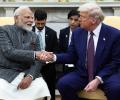
No one should make China an issue in their bilateral relations and their cooperation should not harm the interests of another country, the Chinese Foreign Ministry said on Friday reacting to queries on the meeting between Prime Minister Narendra Modi and United States President Trump.
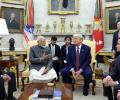
India and the United States have agreed to deepen their strategic partnership in several key areas, with President Donald Trump announcing plans to provide India with F-35 fighter jets and billions of dollars in military supplies. The two leaders also discussed energy cooperation, critical technologies, connectivity, and countering terrorism. They agreed to work together on the India-Middle East-Europe Economic Corridor, and Trump noted India's reforms to welcome US nuclear technologies. Prime Minister Modi said the two countries can shape a better world through their cooperation. Both leaders also addressed the Russia-Ukraine conflict, with Modi stressing India's commitment to peace.

Reports (not denied by India) that the USA had 'for the first time provided real-time details to their Indian counterparts on the Chinese positions and force strength in advance of a PLA incursion' into Tawang at the LAC in December 2022, helping India thwart China's expansionist designs, show how operationally effective the USA-India friendship has become on the ground. A engaging excerpt from Sreeram Chaulia's must-read new book, Friends: India's Closest Strategic Partners.
The real intention of the 'Tariff Man' (as Trump calls himself) may not even be to put the 'Tariff King' (as he describes India) on the mat with a knockout punch but to arm-twist the Indian leadership to agree to some multi-billion dollar mega arms deal, argues Ambassador M K Bhadrakumar.

The scaling up of the India-US strategic partnership to the level of non-NATO ally with defence deals, sharing and transfer of defence technology, interoperability, joint collaboration and joint production of defence equipment has exacerbated Moscow's anxiety, notes Rup Narayan Das.

India and the United States have announced a groundbreaking 10-year defence partnership, paving the way for increased military cooperation and potential sales of F-35 stealth fighter jets. The agreement aims to bolster both countries' defence capabilities in the Indo-Pacific region, with plans for joint production of weapons and platforms. The move comes amid China's growing military presence in the region.

The Quad summit to be hosted by India in 2024 is likely to enhance New Delhi's strategic intent.
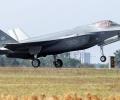
We need to equip the Indian Armed Forces, not 'commercial' as Trump wants, but 'operationally' looking at growing Chinese military capabilities, asserts Lieutenant General Prakash Katoch (retd).
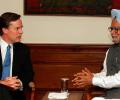
The India-US nuclear deal was aimed at ending India's nuclear isolation and nuclear apartheid, recalls Rup Narayan Das.

'India-US relations seem to have soured when the US expected India to not only balance China in the Asia-Pacific, but also make concessions to Pakistan as a price for US technological help,' says Colonel Anil A Athale (retd).
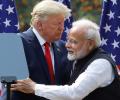
'Trump will absolutely back New Delhi on its position that Pakistan must do more to crack down on terrorists that threaten India.'

Although the credit for acquiring the technological skill must be given to India's outstanding nuclear scientists, the decision to go nuclear was a political one that entailed clarity of vision, courage and resolve, points out Rup Narayan Das.

The American efforts to make India a security partner have enhanced India's importance to Chinese decision makers and new recognition of India's importance and achievements are reflected in a much more positive reporting about India in the State-controlled media, says Walter Andersen.
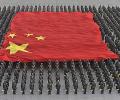
The sudden proximity between India and US has, in the eyes of many, sidelined China. This is not the case, argues Colonel Anil A Athale (retd).

'2020 will show whether India's troubled domestic economic and political house reveals a mismatch in their strategic association or whether closer strategic ties are yet possible,' says Anita Inder Singh.
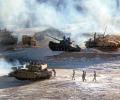
'The Chinese are only about 160-170 km behind.' 'It will not take much time for them to bring their troops back, considering that they have better infrastructure -- and the weather is now favourable.' 'They can move in much faster as the terrain favours them.'

By hosting the 10 ASEAN leaders on Republic Day, India amply demonstrated that ASEAN is a central pillar of its Act East policy. But is India 'central' for ASEAN, asks Dr Rahul Mishra.

Neither Biden nor his successors can any longer ignore the threat China has come to pose to the US in both economic and military fields, observes Virendra Kapoor.

As Japan beefs up its defences against China, both New Delhi and Tokyo seem to have decided to re-energise their relationship to ensure a strategic balance in Asia. It is a clear signal that they may be ready to work together in containing if not confronting China, says Nitin Gokhale.

The only thing that may salvage Narendra Modi's trip to the US is his meetings with CEOs, such as those of Blackstone, First Solar, Qualcomm, Adobe, and General Atomics, asserts Rajeev Srinivasan.

'If the dimensions of the strategic partnership worked out by India and the US seem like a grand alliance targeted at you-know-who, China had better realise that it has fathered it,' says B S Raghavan, a long time observer of China.

'Even if someone other than Trump had become president, the US distancing from Pakistan and coming closer to India was already set in motion.' 'With Trump openly declaring his intent to take on Islamic extremism, the days of US political correctness are over,' says Colonel (Dr) Anil A Athale (retd).

'This is a historic juncture when the US is in great need of an alliance with India to strengthen its hands in the fierce struggle with China in the Asian theatre,' points out Ambassador M K Bhadrakumar.

'There appears to be greater convergence of interests between China and the US in the Afghan-Pakistan theatre than between India and the US. This is hardly a recipe for a super-alliance,' says former foreign secretary Ambassador Shyam Saran.

India cannot choose its geography and devise regional strategies to dovetail into the Western Indian Ocean hypothesis conceived in the Pentagon, argues Ambassador M K Bhadrakumar.

'Whether it's investments in Kashmir, building naval facilities, or selling top-of-the-range military equipment, Pakistan could well benefit more under Xi's watch.' 'Do Chinese concerns about the 'Islamisation' of Pakistan give it pause about how quickly to move forward with security and economic projects? At the moment the indication is quite the opposite: China is doubling down on its support to Pakistan, partly because of its fears about where the country is headed.'

India needs to have a re-look of whole gamut of its relations with major powers and also prepare for a more turbulent neighbourhood. But such is the tyranny of Indian status quo mindset that any talk of re-look at nuclear doctrine or foreign relations is treated as blasphemy, says Colonel (retd) Anil Athale.

'Alas, the Congress party offers no suggestions as to how to unscramble the omlette it cooked during 2004-2014 on which the Modi government may have since lavishly spread some tomato ketchup,' says Ambassador M K Bhadrakumar.

'In India foreign policy is generally handled by the prime minister.' 'One can clearly see the Vajpayee stamp on all this.' 'Only a person with poetic imagination can weave such a complex web,' says Colonel Anil A Athale (retd).

'It is crucial today to realise where we have reached in this 15 year-period in order to fully and properly assess the profundity of what General Rawat has said,' points out Ambassador M K Bhadrakumar.

'The bottom line is that at least now we should take an honest look at this business of NSG membership (or Masood Azhar for that matter.),' says Ambassador M K Bhadrakumar.

India must present its demands of America confidently, instead of fearing that its pocket will somehow be picked, says Ajai Shukla.
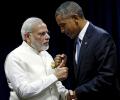
Even as Barack Obama administration officials believe that the India-US relationship has now "emerged at the world stage" and is no longer a "restricted to narrow" South Asia or subcontinental set of issues, they also concede that America's security partnership with Pakistan over the years still poses challenge to India-US relationship.
